Kajukenbo Okayama: Tell us about yourself.
Mitch Powell: My name is Mitch Powell. I’m 65 years old. I live in Las Vegas, Nevada. I live there with my wife, Angel. We’ve been together 48 years. On the 21st of August this year we will have been married 43 years. We met in school.
Angel and I have two sons, Matthew and Dean. Matt lives in Vacaville, California, with his wife Janelle. They have a daughter, Adalynn. She just turned a year old…about a year and two months now. And Dean lives in Portland, Oregon, with his wife, Hannah.
I’m a retired sergeant with the Oakland Police Department. I started working there in the 1980s as a police officer and retired in 2010. While working at OPD I taught a lot of courses - I was involved as an instructor there for a lot of years. Doing that, I found a real interest in education. So I went back to college, got an associate’s degree in psychology…thought that was cool, so I went ahead and stayed in school, and I got a bachelor’s degree in criminal justice management. By then I was kinda hooked, so I stayed and got a master’s degree in liberal studies, with a major in criminal justice.
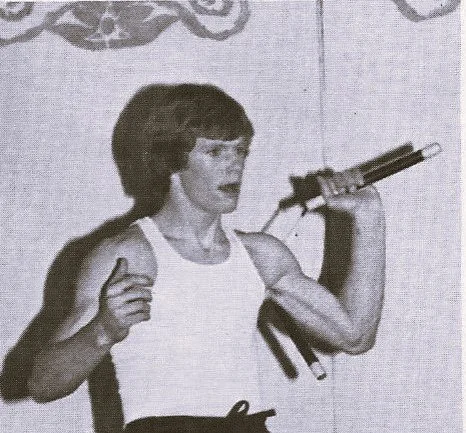
Mitch Powell, age 15, at a demonstration.
KO: What’s your martial arts history and connection to Kajukenbo?
Powell: I began training in Korean Karate (Tae Kwon Do, specifically) at 14 years old.
My teacher, Bill Soto, had gotten sent off to Korea during the Vietnam War. While he was over there, he learned martial arts. Then he came back home, to Winters, California, which is where I was raised. Bill opened a school, and I became a student there.
While I was training at that school, I met a local boxer named Romero Jimenez. Romero was kind of a big deal for the little town that we grew up in. He was the 1969 Golden Gloves Novice Champion in San Francisco, California. And for several years, he was the Yolo County welterweight boxing champion. For whatever reason, Romero and I, we hit it off. And he was, like, seven years older than I was. I was 14, he was 21. He said “Man, I’ll hook you up. I’ll teach you how to box. You just gotta come over to my house.”
Well, Romero…he was married, had a kid at that time…he was living one block away from me. And about three doors down, his parents had a house. And in the back of that house was a stand-alone garage, and Romero had turned it into a gymnasium, a boxing gym. So, me and several of the other kids…we would go over there and box. You could box there every night, because Romero loved that. The more the merrier.
With Romero, I liked boxing because he lived not even a full block away. You had to walk through an industrial area and then boom, there was Romero’s house. And the cool thing about it: it didn’t cost me anything. I didn’t pay any dues. All I had to agree to was to get knocked out 2 or 3 times a week.
KO: [laughs]
Powell: That was the price you paid went you went into that school. And even though I grew up in that school - I don’t care how old or how big I got he could still knock me out. This was one tough dude.
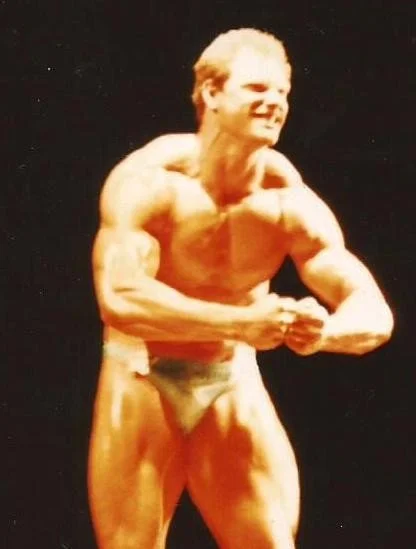
Mitch Powell at the Mr. Santa Clara County Competition, 1984.
So, I was doing that, and about the same time I got the weightlifting bug. I started lifting weights. And I kinda started combining all this stuff together. About a year in, Bill Soto closes his school because he got a job at a Vacaville corrections facility working as a correctional officer. Can’t do it all, so he’s like “hey guys, sorry, I gotta close it down”.
I end up just training with Romero and lifting the weights. And while I’m doing that, one of my buddies from school, Frank Lucero, says “Hey man, you wanna check out a Kajukenbo school? I’ve been going there for a couple of months, and I really like it, a lot.” And I’m like “Sure man. Show me where it’s at.”
So Frankie drives me over to Fairfield, California, and it’s Tony Ramos Kajukenbo. Tony Ramos is one of the pioneers of Kajukenbo. He was trained by the Emperado brothers in the 1950s. In fact, when he started training there it was called “Kenpo”. It wasn’t even called “Kajukenbo”. Ramos trains during that transition period, where it becomes “Kajukenbo”, he leaves, goes to L.A., and then ends up in Fairfield, California, and starts teaching.
We go to his school, out by Travis Air Force Base. I trained there for maybe 7 or 8 months - enough time to get purple belt knowledge. Back then, at least in his system, you had to know 7 grab arts, 7 punch arts, 7 concentration forms and 7 pinan forms. That was for your first belt. And that was a lot of knowledge, because they wanted to weed people out. They didn’t want to waste time on you. If you were willing to learn all of this stuff, then maybe you would stick around for a while, right?
Well, I didn’t stick around for a while, because I got a bug to play guitar. Something changed in my world. I saw Peter Frampton, and it was over; I was gonna be the next Peter Frampton. I started playing guitar. And although I didn’t go to Ramos’ formal classes, Frank did. And Frankie and I, we’d still train together. So, I’m boxing with Romero, I’m lifting weights, I’m training with Frankie, and I’m playing guitar. I still do all of that today. I’m 65 years old, I still play guitar, I still lift weights, I still do the martial arts, and Frankie’s my best friend. There’s a lot of consistency in my life.
So, by this time, I kinda got all of this going on, and then I meet this girl. The girl of my dreams, Angel, who later became my wife. This is 1977, everything is just clicking. I got the boxing, I got the weights, I’m training with Frankie. I got the girl, I got the guitar and I got a band going. We’re a small town and there’s two bands. There’s a band called Sky Blue Beat, and our band, called Red Cloud. If you could go back in time and say “picture the best time of your life”, that was it.
So ‘78 rolls around, and I decided it’s time to do my formal Kajukenbo training again. I join a school with classes taught by Calvin Shin. Calvin Shin was the very first black belt Tony Ramos had. He may have been the earliest Kajukenbo black belt off of the island - if not, he was one of the first. Cal Shin started training in ‘62, and I think he got black belt by ‘64. Really early. He was very, very proficient in the martial arts.
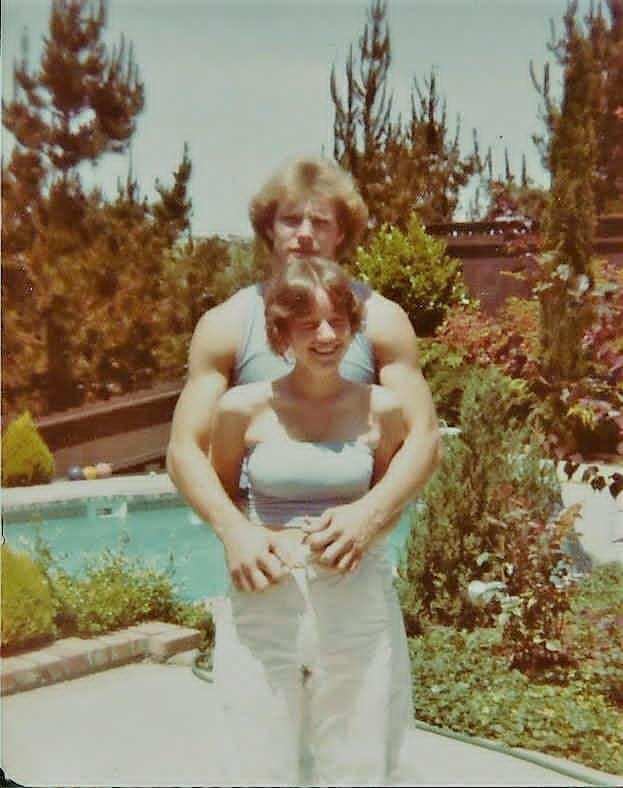
Mitch Powell and his wife Angel, circa 1978.
I start training with him, and I remember I got my purple belt really quickly because I had the knowledge. It was basically the same knowledge I already had; it’s still Ramos method. It’s pretty much the same stuff, technique for technique, form for form - I just had to brush it up and make sure I was doing it the exact right way. And I had to have a little bit of time on the mat so it didn’t look weird right? You know, going in on day “X” and getting a purple belt three months later.
But I got the purple belt quick and I remember I got my blue belt in January of 1980. At this point, I’m beyond lifting weights. I’m deep into bodybuilding, ‘81 rolls around, and I’m training in Kajukenbo but I’m a competitive bodybuilder. I competed in several shows every year until 1984. Then I realized I got tired of going around, measuring my food every two hours to make sure I got it right…I was like “Man, I gotta live my life.” I was married, I had a lot going on, and I said “You know, here’s what I’m gonna do. I’m gonna go get my black belt. I gotta stay focused and get my black belt.”
I was still training in Kajukenbo, but you don’t train with the same intensity if you have more than one thing that you’re enamored with. So I made Kajukenbo my main focus. With Cal Shin, I got all my colored belts: my purple, my blue, my green, my brown, my black. My student black belt I got in 1985. In 1986 I got a first-degree black belt. When I got my first-degree, I got an instructor’s certificate.
Then the lights went on, and I said “Cool. I’m opening a school.”
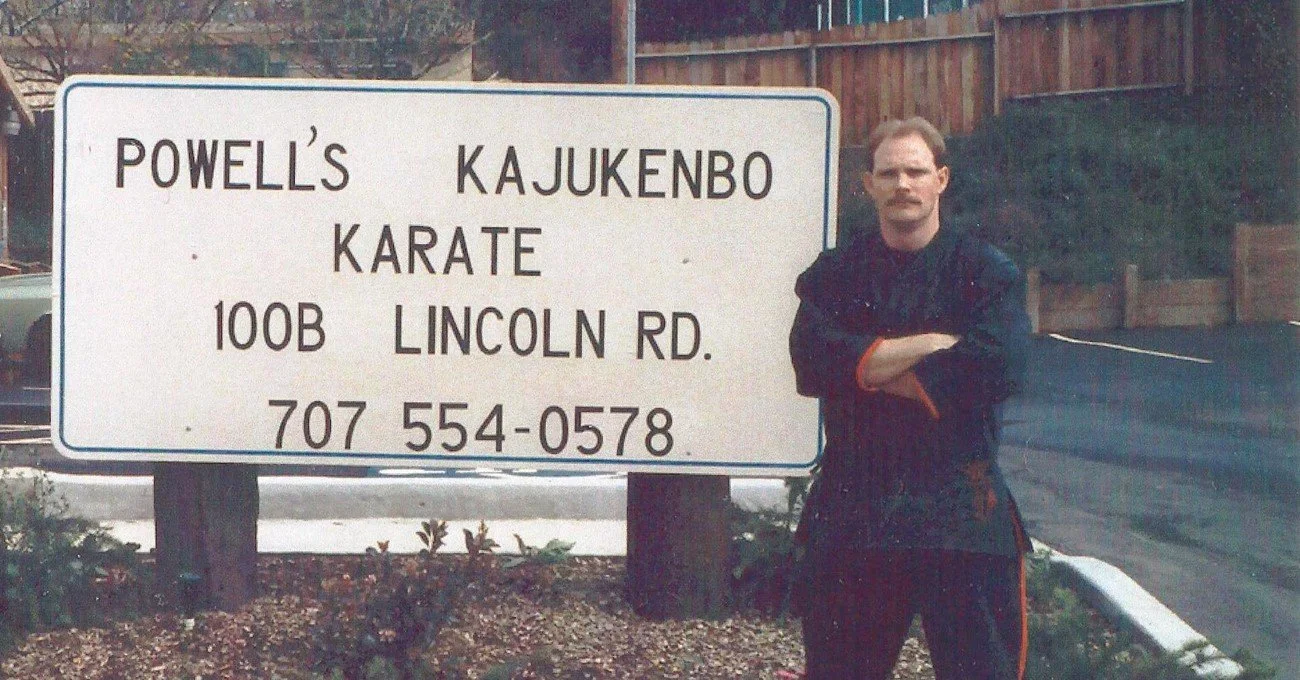
So I open my own school. Mr. Shin was very cool with it. He was like “Yeah, sure man. Do this.” I opened a really nice place on Lincoln Road in Vallejo, California. It was really cool. I kept it open for a couple years, but I had too much on my plate. I had to commute, I was working really weird hours…you know the whole law enforcement thing…it was just bad timing with everything. I had a bunch of colored belts and stuff. My wife’s brother, Tony, had gotten his blue belt, and he was getting really good, and getting ready for the next level. And I just said “I can’t do it” and I closed it down.
Calvin Shin retired in 1989. I was kind of like “Now what do I do?”
Well, I’m a police officer, and police officers have to do a lot of hands-on stuff. I had my Kajukenbo training, which to be honest with you John, it got me in trouble at the Police Department. I got the tap on the shoulder and the “Hey, you gotta slow your role, dude”. Y’know, ‘cause, I’m taking guys into custody and I’m using our Kaj stuff, and the techniques were maybe a little more forceful than they needed to be. So I say “Here’s what I’ll do. I’ll go train with Wally Jay.”
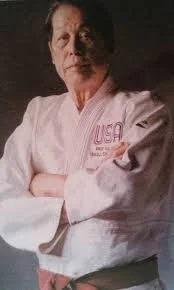
Professor Wally Jay.
I went over to Wally Jay’s house on Eagle Avenue and I trained with him…this is ‘89…and I loved it. Wally was a great guy. A really phenomenal teacher. But he also had great students in there, like Brad Burgo and Lee Eichelberger; just a whole bunch of really good people. I’m training there, 1990 rolls around, and we get bad news: my dad is diagnosed with terminal cancer.
That kinda shut everything down except for work. We had a young son at the time…any free time we had was spent in Winters, 40 miles away from where we lived. Any free time we had, we’re going back, we’re visiting my mom, seeing my dad as much as we can, helping out with stuff. That kind of shut down anything else I was doing besides going to work.
After my dad passed away, I was talking with Joseph Bautista, a very good friend of mine. He said “Hey man, why don’t you meet me down at my dad’s spot, on the weekends, and we’ll train together.” So I did that. As you know, Emil Bautista’s school, 974 Benicia Road. The doors opened in March, I believe, of 1968. Even though Emil’s gone, Betty, his wife, still has that school open. It’s the oldest continuously run Kajukenbo school, as the Hawaiians would say, “eva”. The oldest one eva. Still going strong.
Joseph…I owe him a lot. He really fine-tuned my forms. At the time, he was winning all the forms competitions. He just really helped me out. 1991 rolls around and I decide I’m gonna compete in the Police Olympics. That year the contest was held in Oakland, right down the street from the police department. I figured “Why not compete?”, and I won the gold medal. My main competition was the Lozado brothers, Paul and Ray. Paul was the most decorated police officer in San Francisco PD history and the inspiration for Denzel Washington’s character in Training Day.
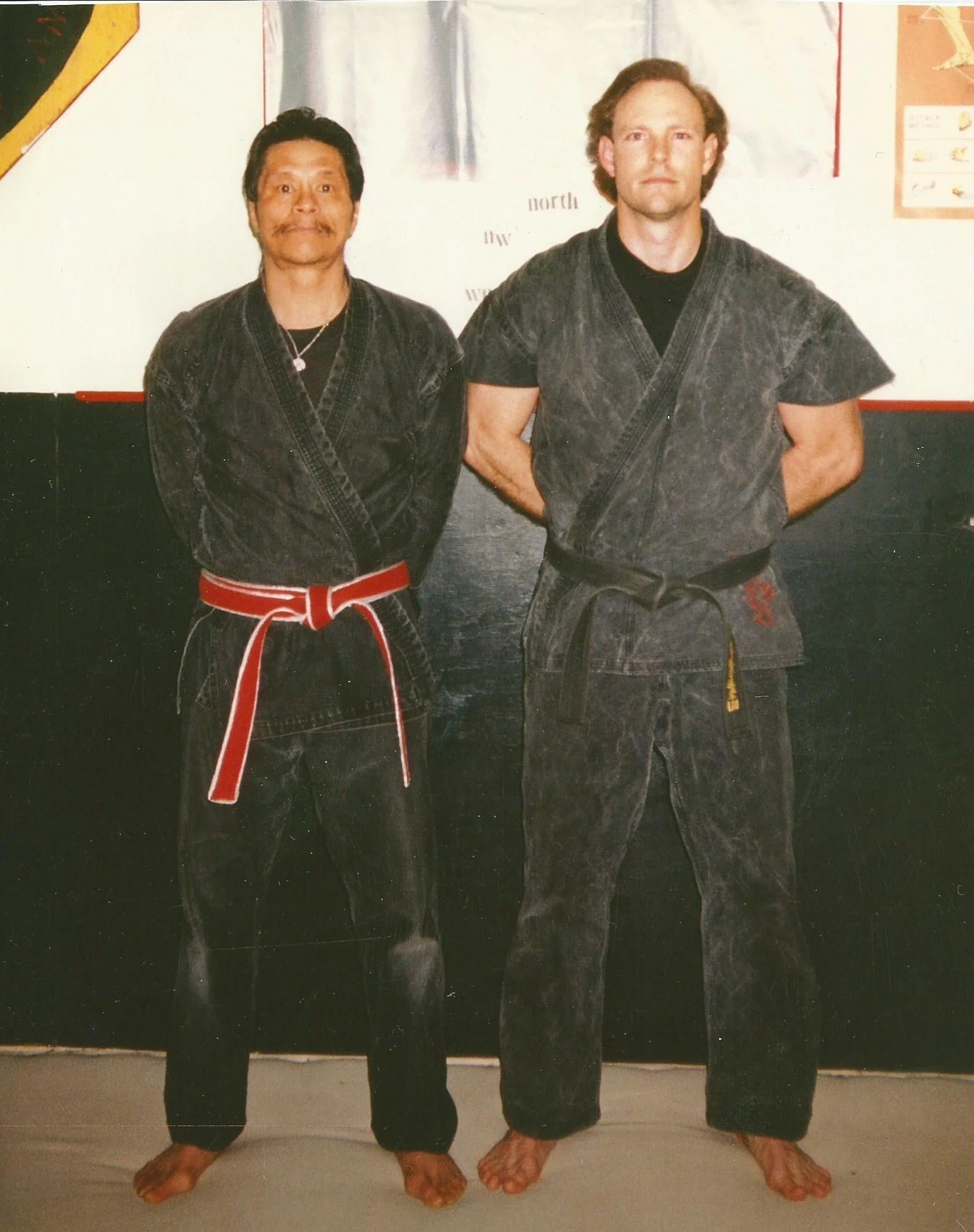
Emil Bautista (left) with Mitch Powell, 1992.
Then 1992: I move my training under Emil Bautista. I get a hold of Sijo Emperado and say I gotta move my training under Emil. I’m at the school, it’s like my home, and Cal Shin’s retired. Sijo and I write letters back and forth, and he says “go ahead, move your training under Emil”, so I did that. I end up becoming one of the primary instructors at the school. I get all my ranks and title from 3rd degree to 8th degree there.
During this time, I became part of this group of friends with Sijo Emperado and his family. You had the group that was always around him, like Greg Harper and Ted Sotelo and all these guys. I got to be in that group, and I ended up getting dual certificates, almost every time. I’d get promoted to whatever degree and then I’d get a certificate from Sijo and the KSDI. To me, that was one heck of an honor, no doubt about that. To get recognition from your teacher and from Sijo?
That era, there was also a book store in San Francisco…I think it was called Green Apple? It was a very famous bookstore. We would go there to look for old martial arts books, and it was crazy what you could find for $5. One day after the bookstore we met with Ming Lum for lunch.
We got to the restaurant before Ming did. There were a bunch of people in the restaurant eating their food. We went up to the lady and told her we were there for lunch with Ming. She said “You wait outside.” So we were waiting outside, and Ming comes walking up. He hugs the lady, some guy comes from inside the restaurant…and then the people in the restaurant left. Everyone. They were told to get out. We walked in, we had a center round table. We ate our food. There was no bill.
That was interesting.
In 2001 I went to Japan. While I was there I met up with some martial artists at the military base in Yokosuka and we did a seminar. I showed them some Kajukenbo and they showed me some traditional Karate. Then I went to Osaka, and Kyoto, and Nara… We took a drive to Fuji San; the gas was expensive, that was pretty crazy. I rode the trains, we did the stuff back at Yokosuka. I had a great time. It did get cold, because we were there in February/March. The flowers were just starting to change, and it’s a great time to be there, but I was kinda cold the whole time. [laughs]
KO: [laughs]
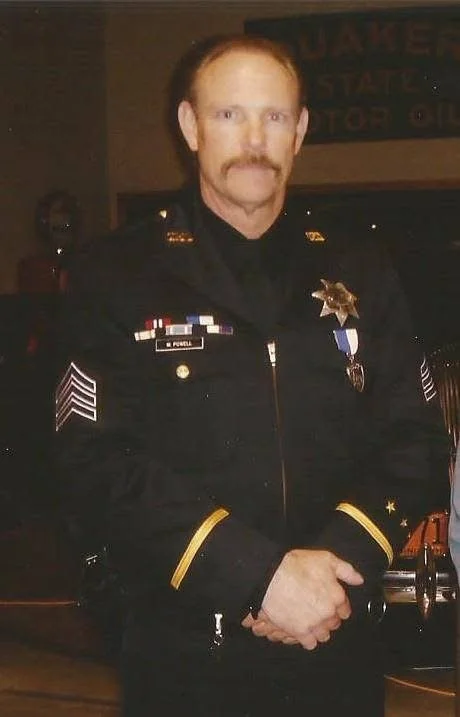
Mitch Powell at the Oakland Police Department’s annual awards ceremony, 2009.
Powell: 2001 was very special for me. Joe Davis and Emil Bautista had been friends since their Armijo High School days. Really close friends. It’s crazy: my son Matt is the principal of Armijo High right now. One of their most famous alumni is Pat Morita, “Mr. Miyagi.” Well, Joe Davis started coming down to our school a lot, and one day he says “Hey Mitch, you oughta learn the alphabet techniques.”
I go “What are those?”, and he says “Well, my instructor’s Aleju Reyes, so we do the Emperado Method. It’s different than the Ramos Method. We have alphabet techniques.”
So he shows me and a couple other guys these techniques. And that led to “Well, do you want to learn the (Emperado Method) punch counters?” “How about the knife/club counters?” “How about the forms?” We ended up learning all of this stuff from Joe Davis, the entire Emperado Method.
In 2004, we decided we were going to make a VHS (that became a DVD) of the alphabet techniques. We did it at Emil’s school. Him and Joe Davis were our technical advisors. We did that DVD, we did Emperado knife/club, we did Emil’s knife/club. We did all these videos. It was me, Dennis Peterson, and Al Saddler. We had a great time. We ended up using these videos as a fundraiser and raising lots of money for Sijo.
After Sijo passed away, Bobby Seronio, one of my brothers in Kajukenbo, put the videos on YouTube. It’s got 30,000, 40,000 views. If someone wants to see it, it’s free to see. It’s also available on my website, www.ukfcertified.com, for free. You can see those are great videos because it’s the original knowledge that Emperado created.
In 2004, I started teaching fellow police officers, and that’s when I started Powell’s Mixed Martial Arts Academy. Prior to that I had taught for Calvin Shin, starting in 1984, and then I taught for Emil, up until 2005. I stayed at Emil’s school for a year, even after I had started the academy. I was teaching students of my own in his school. And I was teaching his students, Joe Davis was in there teaching us; it was like a mecca for a while. You had guys like Woody Sims and Joe Bautista there. There were a lot of really good martial artists in that school.
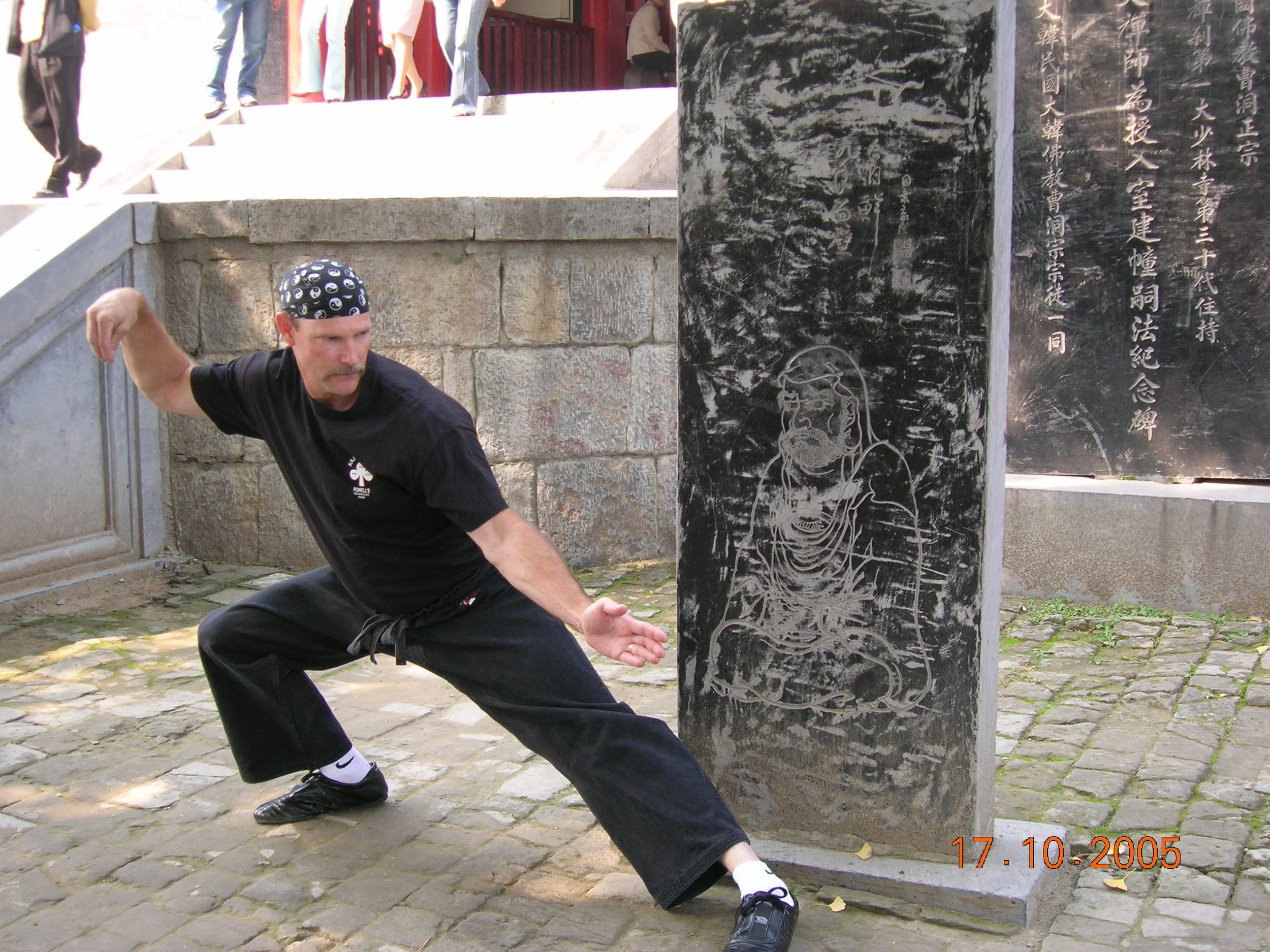
In 2005 I went to China with a group of martial artists, including Eric Lee, the “King of Kata”, and Cynthia Rothrock, who’s done a whole bunch of martial arts movies, and Bob Maschmeier, a lifelong Kajukenbo practitioner, and about 20 other martial artists, including my student and one of my closest friends, Joe Quintela.
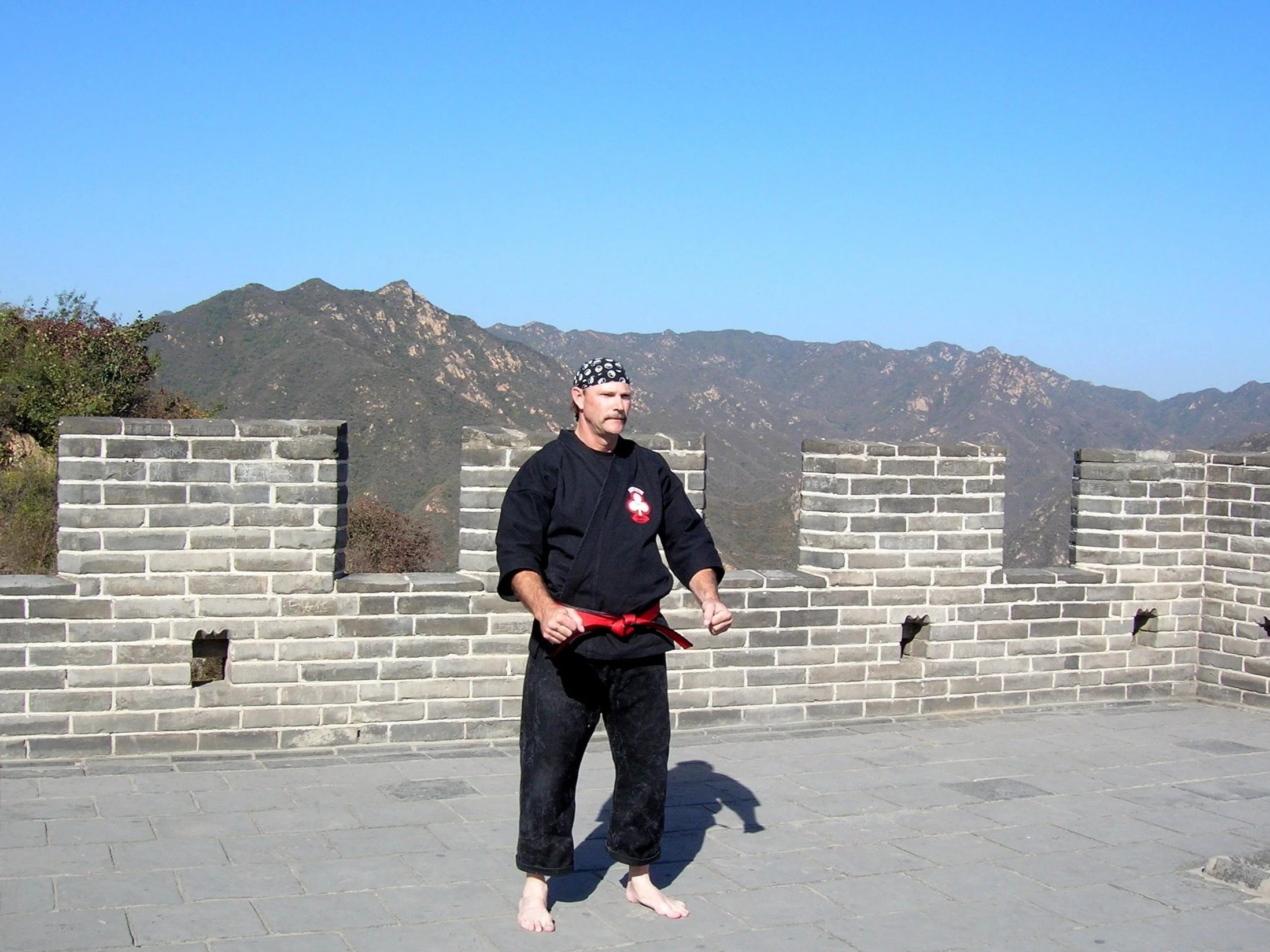
Mitch Powell at the Great Wall, 2005.
We did it all. We stayed at the Shaolin Temple, we performed there, we did demonstrations, we tried to fight the monks…but they wouldn’t fight us.
KO: …What?
Powell: I remember asking our guide if he could go over and ask the monks if they would do something with us. They said “no”. Then I said “Well, will they spar with us?” “No.” “Well, ask them if they want to fight.” He goes and asks them, and comes back and says “No, they don’t want to fight.” I’m like “What a bunch of bitches.” And he’s like “No, they have a vow of non-violence.” So then I felt really stupid. [laughs]
KO: [laughs]
Powell: Anyway, we went to the Great Wall, we did forms, and demonstrations. We went to the Forbidden City. There was a bunch of us out there. It was really, really, cool. That and the fact they had a Starbucks in the middle of the Forbidden City was cool. “Cool”, but not cool.
In 2009, I was promoted to Grandmaster by Sijo Emperado and the KSDI. So things are going really good. I had a lot of good students. I had developed some excellent black belts, including my son Matt. Matt was a much better black belt than I was. He had a lot of different skill sets that I didn’t get to focus on mixing when I was younger. Most of my training was separate: the boxing was over here, the kickboxing was kind of over here…it wasn’t in the same room. When I got my school, the first thing I did was buy 16 pairs of boxing gloves and throw them in the middle of the room. We had a lot going on at once.
I was training a couple of my guys, they were going to go out to a prison to do some mma fights. And I took a thumb in the eye, and I got a detached retina. I didn’t know if something was wrong or not, but I had a bad feeling, because of some issues from when I had gotten some previous lasik surgery. The next day I went to my lasik doctor. She looked at my eye and said “You have a medical doctor, right?”
I said “Yeah. Kaiser, in Vallejo.”
She said “You need to get there as fast as you can, or you’re gonna lose your eye. You have a detached retina.”
I got to the hospital and the doctor examined me. I was told “We got a problem.”
"You have very thin membrane in your eyes. You should never have had lasik surgery done. They had done it multiple times, and I can see it. I don’t have anything to attach the retina to. So I’m gonna take the laser, and do some laser surgery, and try to create scar tissue. If I can get enough scar tissue, I’ll be able to reattach your eye.
Eight laser surgeries later, they were able to reattach my eye. But the doctor said “You cannot get hit in the head. Ever. The risk is just too great. If it detaches, I don’t believe we’ll be able to reattach it again.”
Everything in my life was going right, and then boom. This happens. I wasn’t the kind of guy that could walk around and talk and tell you what to do. If I taught boxing, I was boxing. If I taught grappling, I was grappling. We were rolling. If we’re doing mma, I’m doing mma. When you went out for your promotion, I was one of the guys you had to fight. I was either the first guy or the last guy, depending on how tough you were.
KO: [laughs]
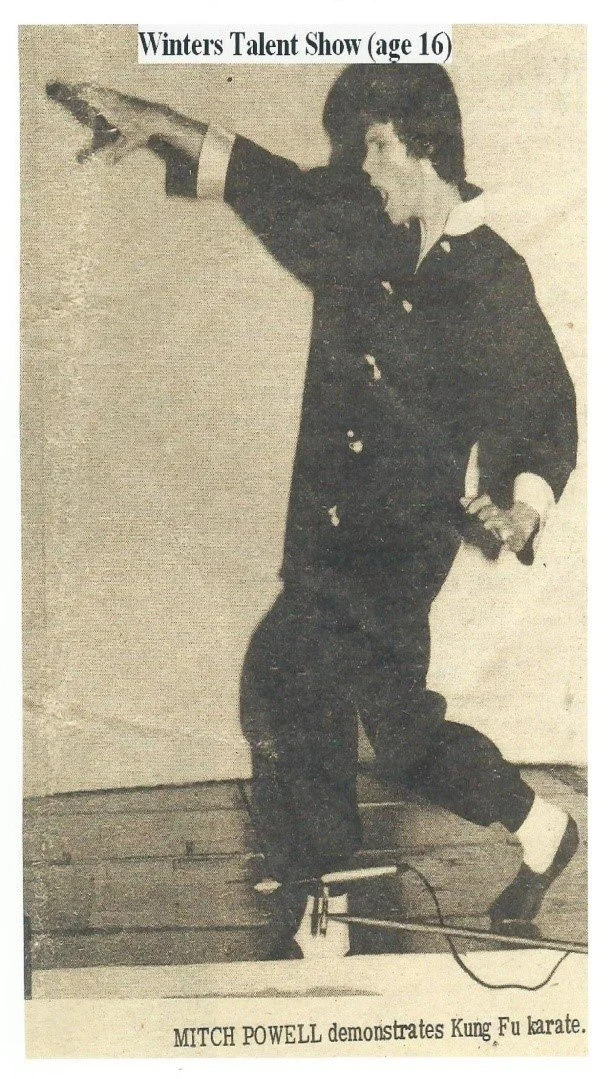
Mitch Powell, age 16.
Powell: June of 2010 rolls around, and I’m old enough based on our contract with the city of Oakland - I decide I’m going to retire from the police department. So I did. I was 50 years old. In December of that year, I decided I’m going to close my school. But I’m gonna have one more test. Whoever’s ready, we’ll have you test.
It was cool, because I tested my son Matt, and he got his second degree black belt. Matt had been training my son Dean, so Matt tested Dean and Dean earned his black belt. So my two sons earned their Kajukenbo black belts. It was kind of full-circle moment. Y’know, I’m not gonna walk around and tell you how to do this stuff if I can’t do it with you. If I can’t do it with you, I don’t wanna do it.
And although I closed the school up, I still stayed involved with my students who had schools. I would go to their schools and teach, I’d do hand pads, or teach techniques and forms…but I couldn’t get hit anymore. I did the best I could with what I could.
In 2017, I realized that we had all these schools of Kajukenbo around, but I wasn’t sure we were doing all the curriculum the same way. I noticed one school’s techniques were different than another’s. So I formed the United Kajukenbo Federation, with the idea that we would have a centralized curriculum. It would be standardized and we would all do it the same way, based on what Joe Davis had taught us, based on his Kajukenbo bible. We ended up doing the videos, which you can find on our website. It’s all there.
A lot of folks have their own version of Kajukenbo, sometimes modified. We didn’t want to do that. We wanted to go backwards. We wanted to go back to the roots. We wanted to go back and say “Yeah, we know this is the old version, but somebody has to keep it alive.” So that’s what we did with the UKF.
Loran Kelley, over in Carson City, Nevada - he put our website together for us. He and I spent a lot of hours together making sure this had all the right stuff on it. He’s still updating it. It’s a great spot if you’re looking for the old Palama Sets, Punch Arts, etc.
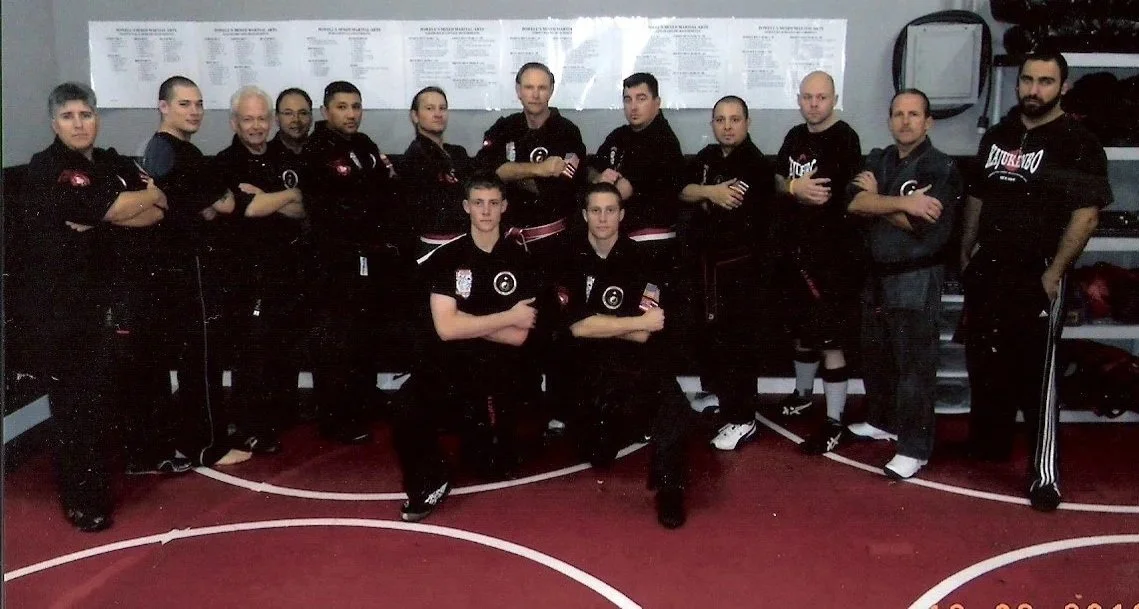
Powell’s MMA, 2010.
KO: How did you become the Kajukenbo historian, and what does that entail?
Powell: Around 2012, Glen Fraticelli was appointed Deputy Chief of the Kajukenbo Self-Defense Institute. The organization created by Adriano Emperado in the 1950s. Glen and I began exchanging some historical information. I had some photographs, he had some photographs, I had newspaper clippings and military records…anything to do with Kajukenbo in its early days, I started swapping with him. And we both realized we both had this immense passion for the history of Kajukenbo.
In the years that followed, I gathered a lot of historical information, from people like Glen, and people like Al Saddler, and Bobby Seronio…Bobby and Al, their grandfather was Pauly Seronio, Charles Gaylord’s teacher. Pauly Seronio was one of the first black belts in Kajukenbo. So, they got information from him that they started sharing with me.
When I got all of that information, I started writing articles. Or just little things I’d post on Facebook, about Kajukenbo, about its early history. As you know, I started finding information that didn’t really match the historical information about Kajukenbo and its early beginnings. I started presenting the necessary documents in the articles I wrote. “Here’s the military record,” or “here’s the birth certificate”, or “here’s a dated photograph of these guys together”.
When I started doing that, Glen and Kimo Emperado, who is the chief of KSDI…we all started talking because we wanted to be accurate with the information, and didn’t want to put out the wrong stuff…and we just started to become friends. Through that, and the articles that I’d written, they told me “Hey look, we’d like you to be the historian for the KSDI.” A huge honor.
As far as “what it entails…” I’m gonna say to continue to research the history of Kajukenbo. If I find information related to the founders or the early development of Kajukenbo, that I put it out in books, podcasts, interviews like this. We gotta keep it as accurate as we possibly can, because now it’s not just me saying something; now I’m representing KSDI.
KO: Did you get much pushback for the history that you presented?
Powell: I got a little pushback from the folks in Hawaii, but now what I get is “Yeah, we knew that, we just didn’t want to say that.” A lot of the guys were familiar with the real history, but they didn’t want to upset the apple cart. When I asked them, every one of them would say “Yeah, not only that, here’s some more info for you.”
I don’t rely on hearsay until I can prove it, but I’m gonna say that the information I put out in my book recently is about as accurate as you’re gonna get right now.
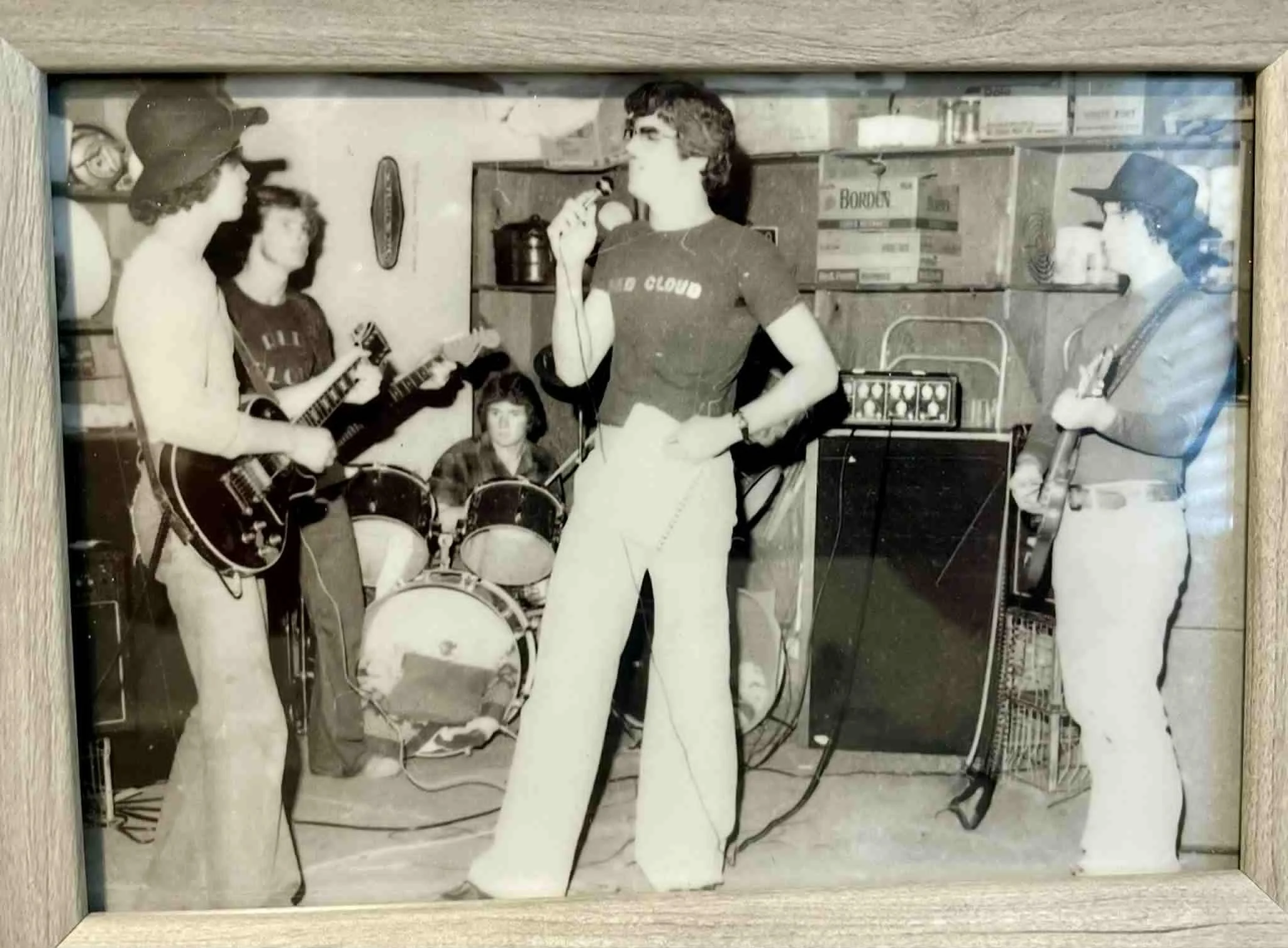
Mitch Powell (second from the left) with his band, Red Cloud.
KO: How important is accuracy in reporting Kajukenbo history?
Powell: I think accuracy is very important, obviously, but I do know that information can change. When I was conducting research for my book and all my stuff over the years, I had this tendency to find new information - experiences that over years make you realize that even our history is going to change. It has changed. As we continue to do this over the years, it will continue to change.
So accuracy is really going to be dependent on two things: that point in time that you’re measuring it, and how honest you are as an investigative writer. If you have biases, if you want research to say something, you could probably make it say that. For me to be honest as a researcher, I need to make sure that the information we’re using tells the true story. For me, if the information that you’re using tells a story, it tells a story up to this point in time.
I would think over the years, the next 5 years, 10 years, or whatever, we should have more information about our history. And so, things will change again. The amount of change will be dependent on the biases of writers. If they want everything Mitch Powell said to be true, then it will be the same. But if they go, “Wait a minute. I don’t think Mitch was right about this, because look at these documents.” I hope they have enough integrity to make the change.
So yes. The accuracy is very important.
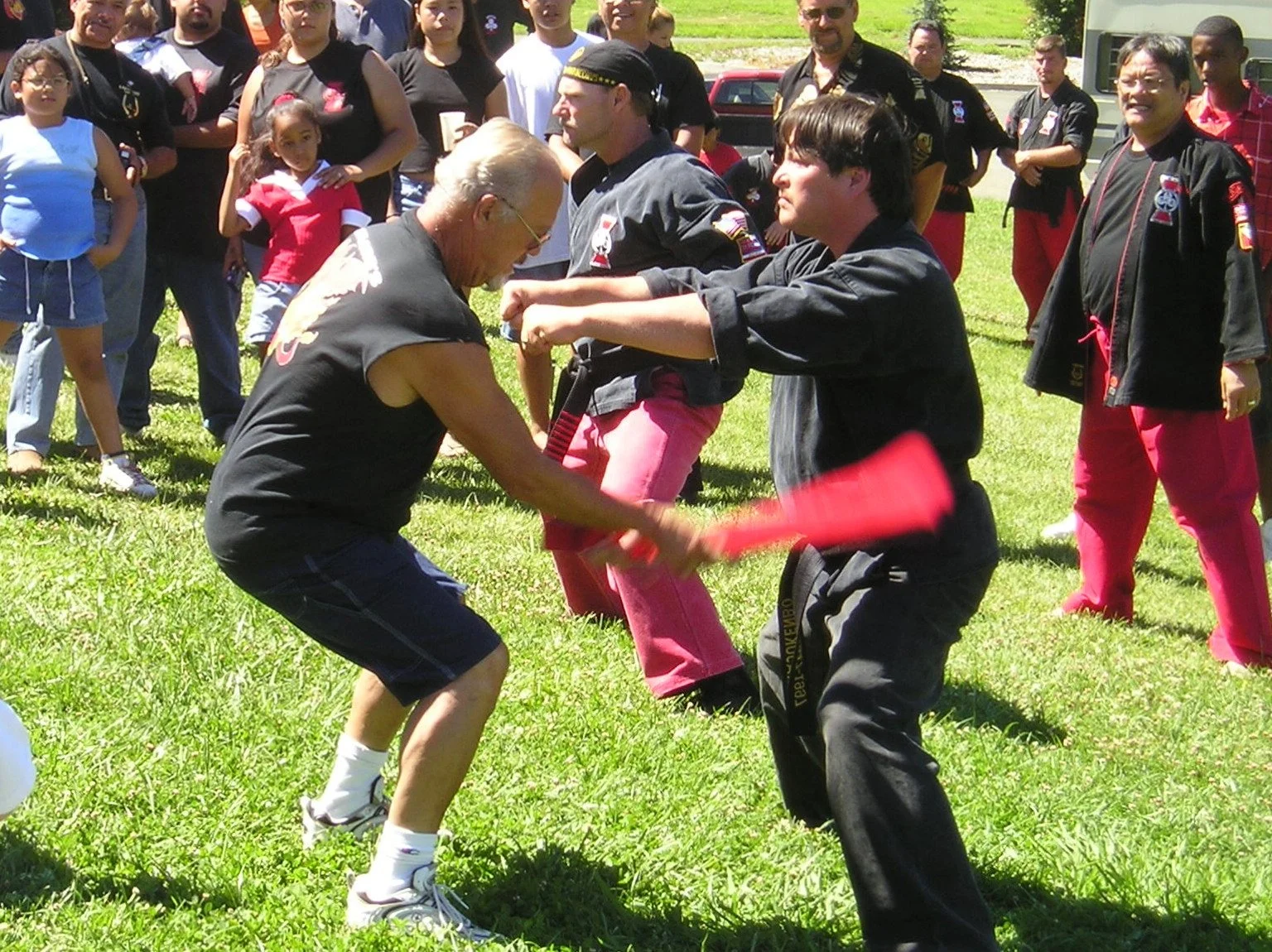
KO: Do you feel that Kajukenbo practitioners are pretty good with that level of honesty with themselves, as far as our history, or are they struggling with it?
Powell: Well…some folks have done a better job at teaching their students history. And for some of us…because our own ego gets in the way, our own history isn’t all that accurate. We don’t tell the right date the we got our black belt, or the date we got an instructor certificate, or when we started. You can always see those big gaps in their training…there was probably a lot of downtime for some people.
There’re honesty issues in a lot of places. But then the guys I look at, the Emil Bautistas, the Calvin Shins…they started training and never stopped. Joe Davis started in, I think, June 20th, 1962, and he just kept training. He had his own schools, he trained his own students…there were no gaps. Carlos Bunda: no gaps. From the beginning until today, the guy could probably still beat up half the people in the room. And he’s in his 80s. So the honesty really comes from the instructors.
And then there’s a lack of knowledge. When the whole “Kajukenbo was created by 5 masters” thing was talked about, that became the new norm. “You know, the Kajukenbo founders were all masters.” And then it got worse, because they made them “masters of a specific art each”. They were creating this image of five “perfect masters” that had mastered their arts, and we could put them together to create this “super art” created by the master’s master’s masters. It reminds me of our ranking structure.
We had a grandmaster, and then we had senior grandmasters, then we had great grandmasters, pretty soon we’re gonna have senior great grandmasters. It’s just this typical evolution in growth I guess.
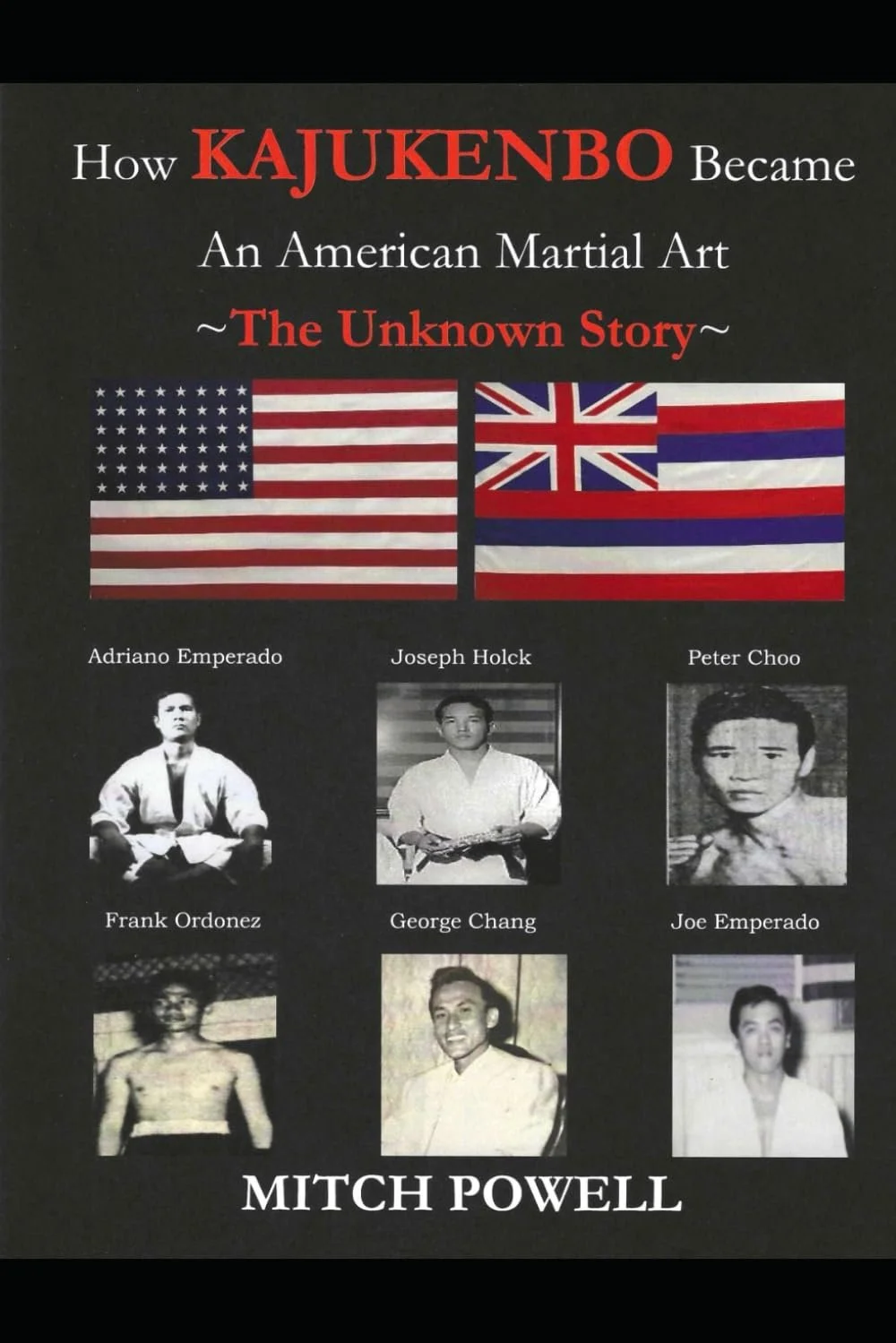
Book available at this link here.
KO: Tell us more about that book, How Kajukenbo Became An American Martial Art: The Unknown Story.
Powell: Y’know, I started doing all this research a long time ago, years and years ago. I really had no intention of writing a book. In fact, I was with John Bishop a couple years ago at the Kajukenbo Gathering at Las Vegas. John and I were sitting together, and someone was talking to me about writing a book and I said “I don’t need to write a book. The only book we’ll ever need is the one’s John’s already written. I’m never gonna write a book on Kajukenbo. And, y’know, a year and a half later, I wrote a book on Kajukenbo.
KO: [laughs]
Powell: So, it’s funny. And John did a great review of my book on Amazon. We are friends. He is a mentor of mine, as far as historical writing. John and I have been friends for decades. But the reason I ended up writing that book is that Glen and I, we were trying to do something different for this year’s Gathering. Maybe it was more my idea, but I wanted to write something historically, and we would hand it out, so that everyone who comes would get this history of Kajukenbo, and it would be based on what I know.
As I’m getting ready to write all this stuff, I have all these newspaper clippings and documents all set out on this desk. And as I’m doing that, I could hear this voice in my head, and it was Woody Sims. For years, Woody kept saying “Mitch, write the book, write the book.” I could hear his voice just saying “Just write the book.” Whatever happened, it clicked and I just said “Okay, I’m writing this book.”
I closed the door in my office, and for the next couple of weeks, I typed away. I figured out how to do all this stuff to set up the book. I had a draft, and I gave a draft to my wife and to Loran Kelley. They both read it, they both gave me some feedback. I added a chapter, moved things around, and I was done. And I didn’t know what to do. And that’s when I reached out to you (Kajukenbo Okayama). I said “John, I got a book, but I don’t know what to do.” And you’re like “You need this, this, and this…”
I took notes on everything you said, I did everything you said. I followed whatever you told me. I had written a lot of stuff with the police department, using Microsoft Word, writing a lot of manuals and procedures while I was there. So I didn’t have any trouble at all. I created my document in Word, I created a PDF from there and I just uploaded the PDF and I was done. I was done so quick I had no idea I was done.
I had everything, and it was time.
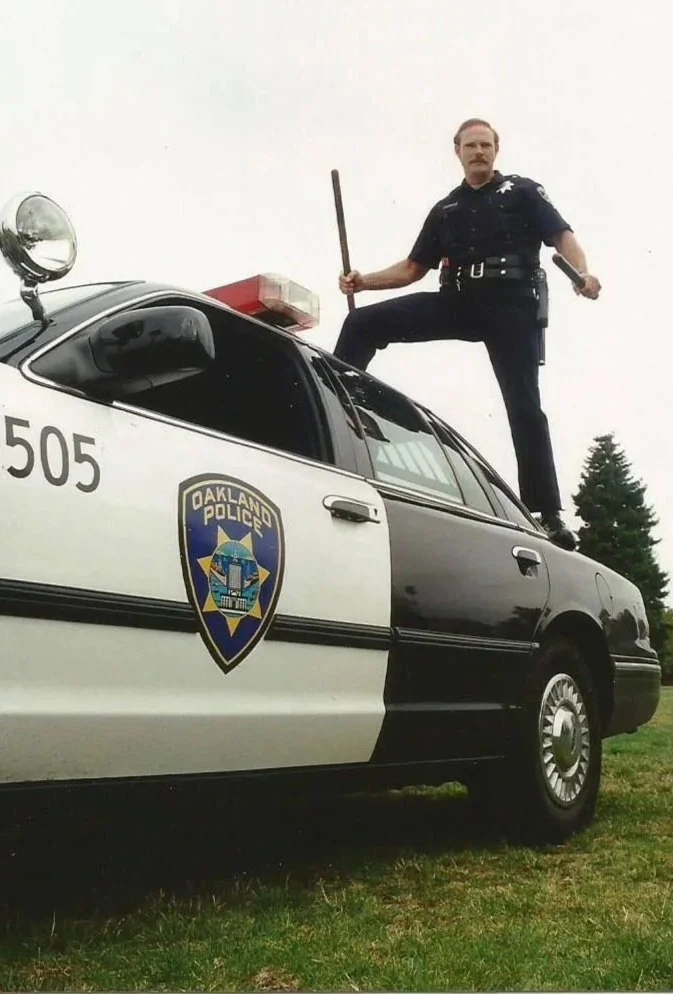
KO: How did martial arts affect your time on the police force?
Powell: I know from my personal experience that I used a lot less force than some other officers I worked with, because I had a martial arts background. I could think of situations where I should have probably used deadly force, but didn’t. For that reason, I didn’t have to deal with killing that person or going through the legal ramifications of taking their life. I think the martial arts helped me out a lot there. Don’t get me wrong - it was Oakland. I had my fair share of life or death situations. I’m just thinking of some of those situations where I didn’t have to end up using deadly force.
I have one example I like to share, especially with people who say Kajukenbo knife techniques aren’t practical. When they were creating Kajukenbo, Sijo said “We created knife and club techniques to deal with a criminal on the street who might be armed with a weapon.” He didn’t say they created it to fight a Filipino knife fighter. It’s for some knuckle head on the street who has a club. Some knuckle head that has a knife. That’s where those techniques are used; they’re self defense based, for those kinds of situations.
I remember one time: it was a Sunday morning, I’m driving my OPD car, heading over to a call. I’m in full uniform, the sun is shining, the birds are chirping. I think I was working overtime, so it was time-and-a-half day. It was one of those beautiful moments in a police officer’s career. I think I had a cup of coffee, I’m tooling down this road. Someone on the radio says “Check this disturbance.” I get to this little, dinky house with a big ol’ front yard. You gotta park and walk across the yard, and there’s these steps going up to the house, three steps.
There’s a guy facing a screen door and talking through it. I walk up right behind the guy, figure I got decent distance from him. I ask “Is everything okay?” He turns around, and he’s got a long kitchen knife. The longest one in the kitchen block, he’s got that one. He decides he’s gonna get me, gonna try and stab me in the face or neck or whatever. I blocked it with an upward block, grabbed his arm, turned him sideways, took him to the ground, banged his arm on my leg until I got him to let go of that blade.
Never thought about shooting him. I had done this a million times in the school, and now I was doing it a million and one. Block, wrist lock, armbar takedown, smash and break, get the weapon. I go to turn his arm so I can cuff him and I realize the problem. This guy is a lot bigger than I am, and he’s wearing a long sleeve shirt, and the sleeves aren’t buttoned.
For you to put handcuffs on, you gotta get the sleeves up. You can’t get the cuffs over the sleeve. It’s just too awkward, and too bulky. So I get one arm, and I’m trying to get the sleeve up to get the cuffs on. I can’t do it, ‘cause now he’s moving around. And he’s probably 240. I was maybe 195. I was pretty big, had a lot of muscle, but when the guy’s 50 pounds heavier than you it takes a lot.
Well, I look across the yard and there’s a chain link fence. I figure, “If I can smash his face into that fence, I can get his legs spread apart and have a little leverage.” I used a wrist lock to bring his body up and then run him across and slam him into the fence. Then I manage to get the shirt up and I’m cuffing him up. All of a sudden I hear all of this noise. Sirens, tires screeching. I’m starting to turn the guy and pat search him, make sure he doesn’t have any other weapons. And all of these police officers suddenly converge on the house.
Ends up, the neighbor saw what was going on and called in and said “Hey, there’s a guy out in the front yard trying to kill one of your police officers.”
So they all show up, the cavalry is now here. I’m walking the guy to the car and I ask “Hey guys, what’s going on?”
KO: [laughing]
Powell: They said “You weren’t answering your radio.” I said “Yeah, I was a little busy.”
So I got the guy searched and put in the back of my car, and my sergeant walks over and he says “What the heck happened?” So I tell him, and he goes “Why didn’t you shoot him?” I go “I didn’t have to.”
Technically (following statistics and police procedure), I should have shot him. You don’t block a knife, etc. But through my martial arts training, I didn’t feel a threat. It was just another exercise that I’ve done a million times.
That’s an example of how having those skills could have been a detriment. I could have gotten killed right there. But I used my skills, the guy didn’t die, I didn’t shoot him.
Turns out, John: that guy had been in a car accident. A really bad one. And he had ended up with a prefrontal lobotomy. His wife…ex-wife…was in the house that he was at that day, with her new boyfriend. He didn’t have enough sense to know that she was never coming back. They lived relatively close to each other, and he was trying to tell her to come home. But she didn’t live with him anymore. So, even if I’d have killed him…he didn’t know what he was doing. He was not operating with the ability to reason and rationalize.
I’m sure if I had killed that guy and found that stuff out afterwards, that probably would have been one of the last days I worked. I value the fact I had martial arts training and I didn’t go down that road.
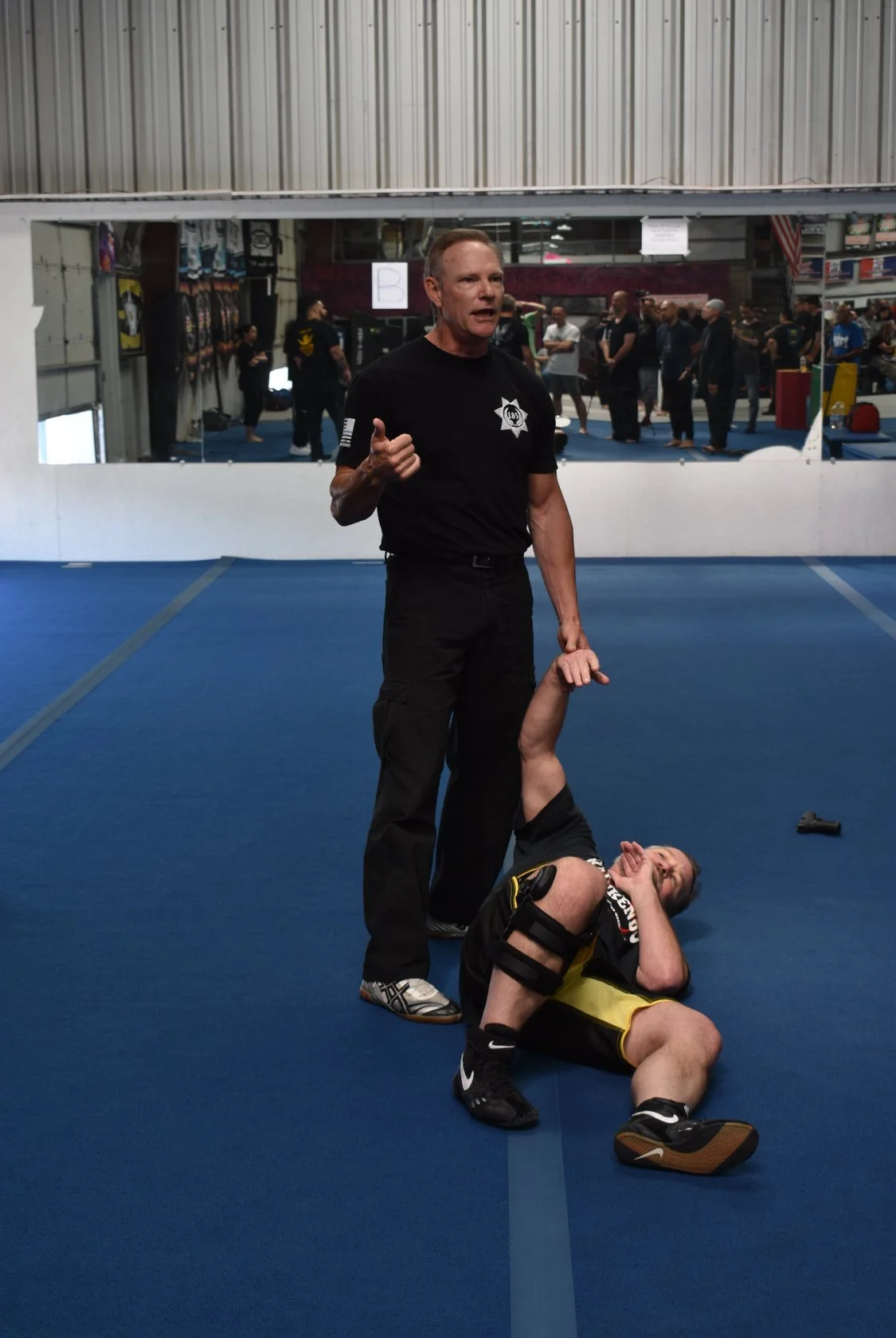
KO: You seem happy that you didn’t shoot the man. Can you explain what you meant by it being “technically” better to have shot him?
Powell: Policy, procedure, and a threat risk. To take someone’s life, you have to show that danger was eminent, that the intent, means, opportunity, and ability were all present and created a risk of facing great bodily harm or death. So, it’s pretty obvious that the guy with a knife could kill me. Could cause great bodily harm or death. My response should have been deadly force, to protect my own life. Or maybe he kills me and then he goes in and kills the people in the house.
That’s why those rules are put into place like that. They don’t say I had to kill him, but it said the most logical response was to use deadly force, to stop the threat. Whenever a police officer uses a fire arm or any force, the intent is just to stop what’s going on. You’re never intending to harm someone to the point of killing them; you’re just trying to stop threat.
But if you shoot a guy, you’re not gonna shoot the knife out of his hand. You’re gonna put two to the body and one to the head. And if I had done that, he would have been dead or a vegetable.
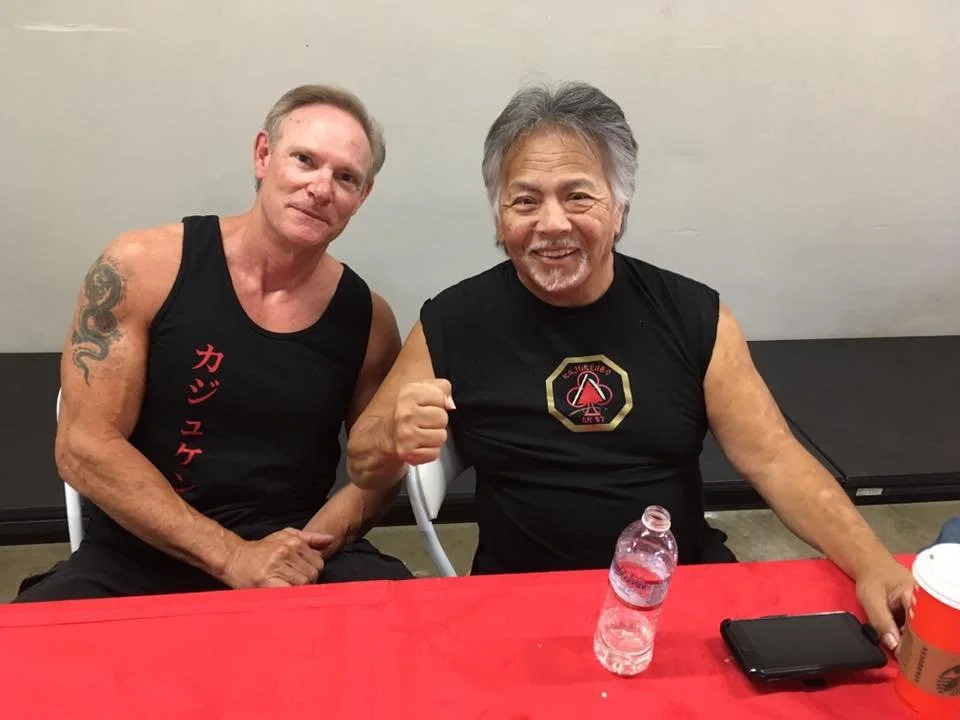
Mitch Powell with Ted Sotelo.
KO: What martial artists did you/do you look up to?
Powell: I think just about everyone my age idolized Bruce Lee. I first saw him as Kato, in the Green Hornet. Then I saw his movies. He was bigger than life. I don’t know a single person on this planet who wouldn’t have liked to be able to fight like Bruce Lee. Whether he was your idol or your yardstick or whatever…I’m pretty sure everyone I know would say Bruce Lee.
But as a teenager, there was a kid in Vallejo named Bobby Wilson. Bobby was a student of Bautista’s. Bobby won so many tournaments. He was such an excellent martial artist. Such great, great timing. He had power, speed, accuracy. He was smart. Even before I knew who this guys was, I’d see him at tournaments. Frankie and I would go to the tournaments just to see Bobby fight, even if we weren’t competing.
And Bobby didn’t know me from Adam back then. Later on we became friends. And it was cool, because many times since then I’ve been able to tell Bobby “Look, dude, you were my hero.” He’s still a great martial artist.
I remember at the 50th Kajukenbo anniversary get-together, in Vallejo, California, Bobby went and fought again. Bobby is my age, so he’s no spring chicken, and he was still the baddest man in the room.
As an adult though…I have to say I met Ted Sotelo in my 30s. Unquestionably, Ted Sotelo was the best martial artist I have ever seen, ever trained with, or ever known. He was doing stuff so unbelievably great. His hand stuff, his concepts, just the way that he practiced…he had an infamous garage in Las Vegas, where he lived. There were some pretty tough characters that went in there to try and make Ted understand how tough they were. And there are some great stories about how that went miserably wrong for so many people.
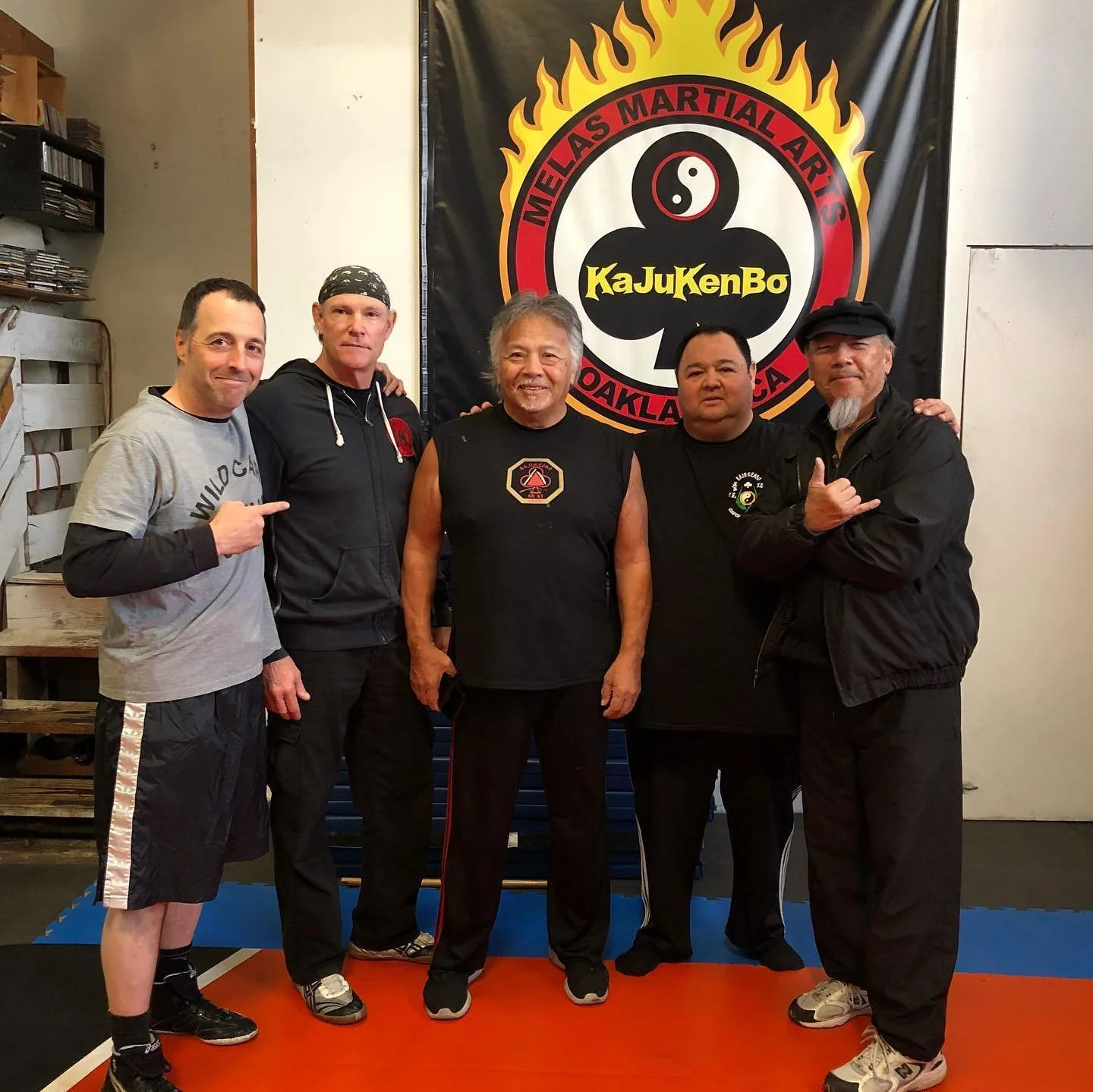
Mitch Powell (second from left) with Nick Melas (far left), Ted Sotelo (center), Al Saddler (right of center), and Ron Lew (far right).
I was actually at a function Bob Maschmeier had invited me to. So I’m in there, and there’s this body-builder dude, who was pretty yoked. This other guy from Italy, standing with him, was talking with me about Ted Sotelo. In broken English he asks “Do you know Ted Sotelo?” I go “Yeah”. He says “Did you ever hear the story about the guy whose head went into the new refrigerator and dented it?” And I go “Yes, I had heard that story. Ted’s wife was really pissed. She had just bought that new refrigerator.” And he said “See this guy behind me? It was him.”
He was a big ol’ boy, and he did not want to talk about that at all. But the Italian guy was just busting up. “Oh yeah, he just destroyed that refrigerator.”
KO: Ted Sotelo was a legend.
Powell: Ted was my guy.
He passed away on August 24th, 2018. And I miss that guy every, single, day. He was our Bruce Lee. If Bruce Lee had been alive long enough, he would have been Ted Sotello.
KO: Best martial arts movie?
Powell: Man. I don’t know. I’m gonna say I like this movie called “Black Belt”. All of the Bruce Lee movies, for sure. If I had to watch one movie for the rest of my life, it would probably be Enter the Dragon. I liked Return of the Dragon a lot.
It might sound cheesy, but I’m gonna throw Van Damme in there. I think Van Damme made some great movies. Bloodsport was incredible. And people, please don’t throw stones at me, but I’m a fan of Steven Seagal. He made some really fun movies, great to watch. He did things that other people hadn’t don’t yet on the screen.
I’m a fan, so I can look beyond the crazy stuff.

Mitch Powell (center) with his sons, Matt and Dean.
KO: What are your hopes for Kajukenbo in the future?
Powell: I’d love to see the martial art of Kajukenbo continue to grow. Because it has, but I have some serious concerns.
Number one concern: too many instructors have been promoted that didn’t earn the rank. They paid someone some money, they got promoted. Or some teachers decided they wanted to expand their Kajukenbo organization, so they adopted someone into their system/school and gave them rank. The person in question didn’t earn their rank. It was given. Now that person is under their banner.
And in too many cases, the knowledge…it doesn’t match the belt. And when you’re a high-ranking martial artists, with a 6th, 7th, 8th, 9th degree belt but you don’t have the knowledge…that’s a problem.
Number 2: there are way, way too many Kajukenbo schools, especially abroad, who don’t know the Kajukenbo curriculum. They use the Kajukenbo name, but they don’t know the curriculum. They don’t know the techniques, the forms, the protocols, the concepts, the principles…they don’t know the history of Kajukenbo. That’s a flaw in the process, because we have instructors giving out rank and creating this problem.
It’s not a new problem. For people going “Yeah, yeah, back in the day, we didn’t do that!” Yes you did. This was done in the '50s, the '60s, the '70s, the '80s…we’re seeing it now more than ever because Kajukenbo is bigger. There are more schools, there are more organizations and groups.
We will never really be able to standardize the curriculum in Kajukenbo, because it is no longer a single martial art. It is an umbrella of martial arts. It oversees different versions of martial arts, some of which have nothing to do with the original system. Kajukenbo is an umbrella word like “Karate”.
If you talk “karate” the people who know it will ask “what kind of karate?” “What style?” “What lineage?” That’s Kajukenbo now.
In doing that, we no longer have a real standardization. We had some standardization, but only in groups. Ramos Method, Gaylord Method. What I think we can do now, is get the instructors that are at the head of these lines to make sure they have a standardized curriculum and there’s a source for that curriculum. A place where students and instructors can go to and see all the techniques, forms, protocols, all of the belt requirements and so forth, for their organization.
We did that in the UKF. You can go on the website, and can look at exactly what is required for each belt, for each of the belts. It was hard. It required a lot of effort in several people to put this all together - but it’s worth it. If each teacher at the head of these organizations does this, you might find out that you don’t have the master martial artists under your banner that you think you do. You might find out they only have blue belt knowledge.
The honesty - it needs to come back or at least start. Your belt needs to match your knowledge. That’s my hope for the future: get your knowledge and your belt together. Make ‘em match.
Click here to check out Mitch’s new book, How Kajukenbo Became an American Martial Art: The Unknown Story, available on Amazon.
To read more interviews like this, be sure to check out Blood, Sweat, and Bone: The Kajukenbo Philosophy and The Path: Book Two of the Kajukenbo Philosophy, both by John Hojlo.